

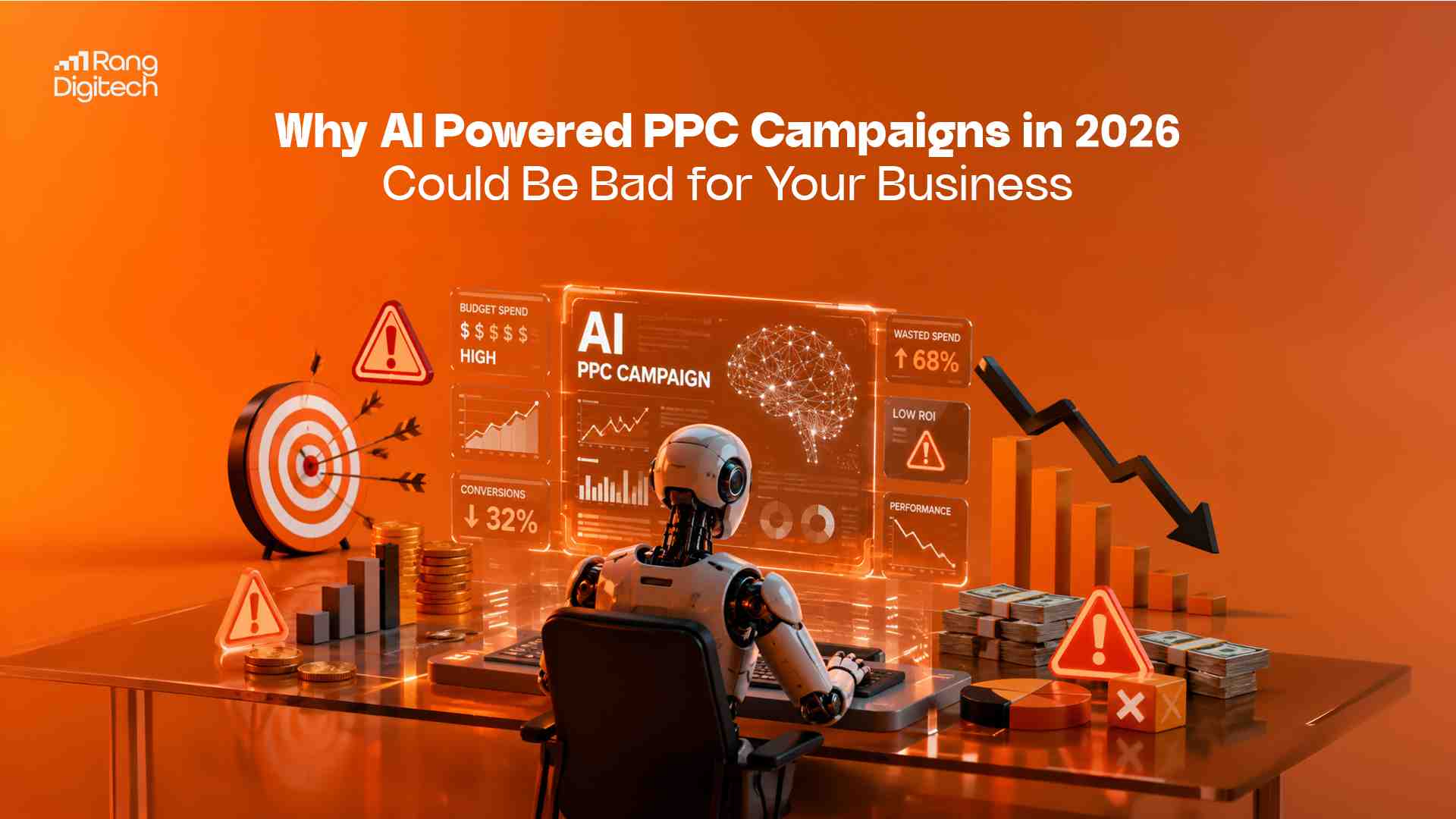
There is a strange contradiction at the heart of digital advertising in 2026. Businesses are being told that artificial intelligence will make PPC campaigns smarter, faster, and more profitable, while at the same time advertising platforms are taking more and more decisions away from advertisers. Google can now automate bidding, targeting, creative combinations, search-term matching, and even landing-page selection. Meta is moving in the same direction. The pitch is simple: give the machines enough data, and they will find the customers you want.
Businesses relying on digital marketing services agency solutions should therefore pay close attention to how automation affects their advertising strategy.
When AI Optimizes the Wrong Thing
But there is a question that deserves considerably more attention: what happens when an AI system becomes extremely good at optimizing the wrong thing?
That is where the real risk of AI-powered PPC begins.
This is not an argument that artificial intelligence does not work. In fact, the evidence suggests that it can work remarkably well. WordStream's 2026 Google Ads benchmark, based on more than 13,000 advertising campaigns, reported an average click-through rate of 6.66%, conversion rate of 7.52%, and cost per lead of $70.11 across industries. Google's own data on AI Max for Search campaigns is even more optimistic.
Google says advertisers activating AI Max typically see 14% more conversions or conversion value at a similar cost per acquisition or return on ad spend. The important qualification, however, is that Google's figure comes from Google's own analysis. It is evidence worth considering, but it is not an independent guarantee that every business will become more profitable simply by switching on more automation.
The distinction between more conversions and more business is crucial.
When More Leads Do Not Mean More Business
Consider a company selling enterprise software. Suppose its Google Ads account records a conversion whenever somebody completes a demo form. An AI-powered campaign notices that certain broad search queries, audiences, and placements consistently generate those forms at a relatively low cost. It therefore allocates more budget toward them. Over time, the cost per lead falls, and the number of conversions rises.
From the perspective of the advertising platform, this looks like success.
From the perspective of the sales director, it could be a disaster.
The new leads might be students researching the industry, very small companies that cannot afford the software, people outside the company's target geography, or prospects with no intention of purchasing. The algorithm has not necessarily malfunctioned. It has learned from the signal it was given and optimized toward it.
This is one of the uncomfortable truths about AI-powered PPC: automation does not eliminate bad marketing strategy. It can amplify it.
Companies working with a digital marketing agency in Vadodara should make sure their campaigns are built around meaningful business outcomes rather than surface-level conversion numbers.
Why Data Quality Matters
Google's own documentation makes the mechanics fairly clear. Performance Max and AI-driven search products rely on objectives, conversion data, audience signals, creative assets, and other information supplied by the advertiser. The machine is making increasingly sophisticated decisions, but those decisions remain dependent on the quality of the information entering the system.
That creates a dangerous possibility for businesses that measure PPC too narrowly. A marketing manager may celebrate a falling cost per lead without realizing that the algorithm has simply become better at finding inexpensive people who are unlikely to buy.
This is why a $30 lead is not necessarily better than a $60 lead.
If the $30 leads produce two customers while the $60 leads produce ten, the supposedly expensive campaign is creating substantially more value. Yet an AI system optimizing primarily around lead volume or a weak conversion signal may not understand that difference unless the business feeds qualified sales outcomes back into the advertising ecosystem.
A strong digital agency marketing strategy should therefore connect advertising data with actual sales and customer value.
How Google's Automation Is Expanding
The problem becomes even more interesting as Google's automation expands.
Google's AI Max for Search campaigns can broaden search-term matching, generate text assets and use Final URL Expansion to send users to pages that Google's systems believe are relevant. Performance Max similarly automates significant portions of targeting, bidding, creative and budget allocation. Google has also introduced controls around areas such as brand exclusions, URL exclusions and negative keywords.
That last development is particularly interesting.
If AI is supposed to make manual campaign management less important, why do advertisers still need increasingly sophisticated controls to prevent the system from pursuing unwanted traffic?
Because automation does not mean the disappearance of strategy. It means strategy moves to a different level.
The advertiser is no longer necessarily deciding which individual keyword should receive the next bid. Instead, the advertiser is deciding what the machine is allowed to pursue, what counts as success, which audiences should be excluded, and which business outcomes should influence optimization.
In other words, the skill is moving from operating the machine to designing the environment in which the machine operates.
For a digital marketing services agency, this shift makes strategic planning and campaign governance just as important as technical automation.
The Attribution Problem
There is another problem that deserves attention: attribution.
A customer may discover a company through Google, return through organic search, read several articles, see a remarketing advertisement, and eventually purchase after receiving an email. Which channel created the customer?
There is no perfect answer.
Yet advertising algorithms still need conversion signals to learn. If the measurement system disproportionately rewards actions that are easy to attribute, an algorithm can end up optimizing toward what is measurable rather than what is genuinely incremental.
Google appears to recognize this problem itself. Its documentation around Performance Max includes experiments intended to help advertisers measure incremental lift rather than simply accepting the campaign's reported conversion numbers.
That distinction is fundamental.
A conversion reported by an advertising platform is not automatically a conversion caused by that platform.
Businesses considering digital agency marketing should keep this distinction in mind when evaluating PPC performance.
Advertising Fraud and Low-Quality Inventory
There is a similar concern around advertising fraud and low-quality inventory. A 2026 report cited by TechRadar estimated that global advertising fraud resulted in $32.6 billion in losses during 2025, while highlighting the increasing sophistication of automated fraud and "made-for-advertising" environments. AI did not invent advertising fraud, but the rise of automated media buying makes the quality of the signals being consumed by algorithms increasingly important.
The more automated the system becomes, the less sensible it is to judge performance solely from the dashboard the system itself produces.
For businesses seeking a digital marketing agency in Vadodara, independent analysis of campaign quality can help prevent automated reporting from becoming the only measure of success.
Why Businesses Should Not Abandon AI
That does not mean businesses should abandon AI-powered PPC.
Quite the opposite.
AI is likely to become an essential part of serious paid-search management. It can process enormous quantities of auction data, identify patterns humans would miss, test creative combinations, adjust bids, and discover opportunities at a speed no traditional PPC manager can match.
The mistake is expecting it to understand the business behind the numbers.
An algorithm may know that one audience converts at a lower CPA. It does not automatically know that those customers have higher churn. It may know that a particular keyword produces more leads. It does not automatically know that those leads have half the lifetime value of customers acquired through another search. It may know which advertisement gets more clicks. It does not necessarily know whether that advertisement strengthens or weakens the brand.
Why Human Expertise Still Matters
This is where human expertise remains essential.
For Rang Digitech, the future of PPC should therefore not be framed as humans versus AI. That is an outdated debate. The more useful question is whether businesses can build the measurement, strategy and governance necessary to make AI work in their favour. Because the greatest danger of AI-powered PPC in 2026 is not that the machine will make stupid decisions.
It is that the machine will make very intelligent decisions in pursuit of the wrong objective. And when those decisions are repeated across thousands of auctions, searches, and users every day, a small strategic mistake can become an extraordinarily expensive one.
The businesses that win with AI-powered PPC will not necessarily be those that automate the most. They will be the ones that understand what should be automated, what should remain human, and, most importantly, what the algorithm should actually be optimizing for. Businesses looking for a digital marketing agency in Vadodara need a strategy that combines AI capabilities with human oversight, accurate measurement, and clear business objectives.
If you are looking for a digital marketing agency in Vadodara that can help you build smarter PPC campaigns while keeping your business goals at the centre, contact us today to discuss your digital marketing needs.