

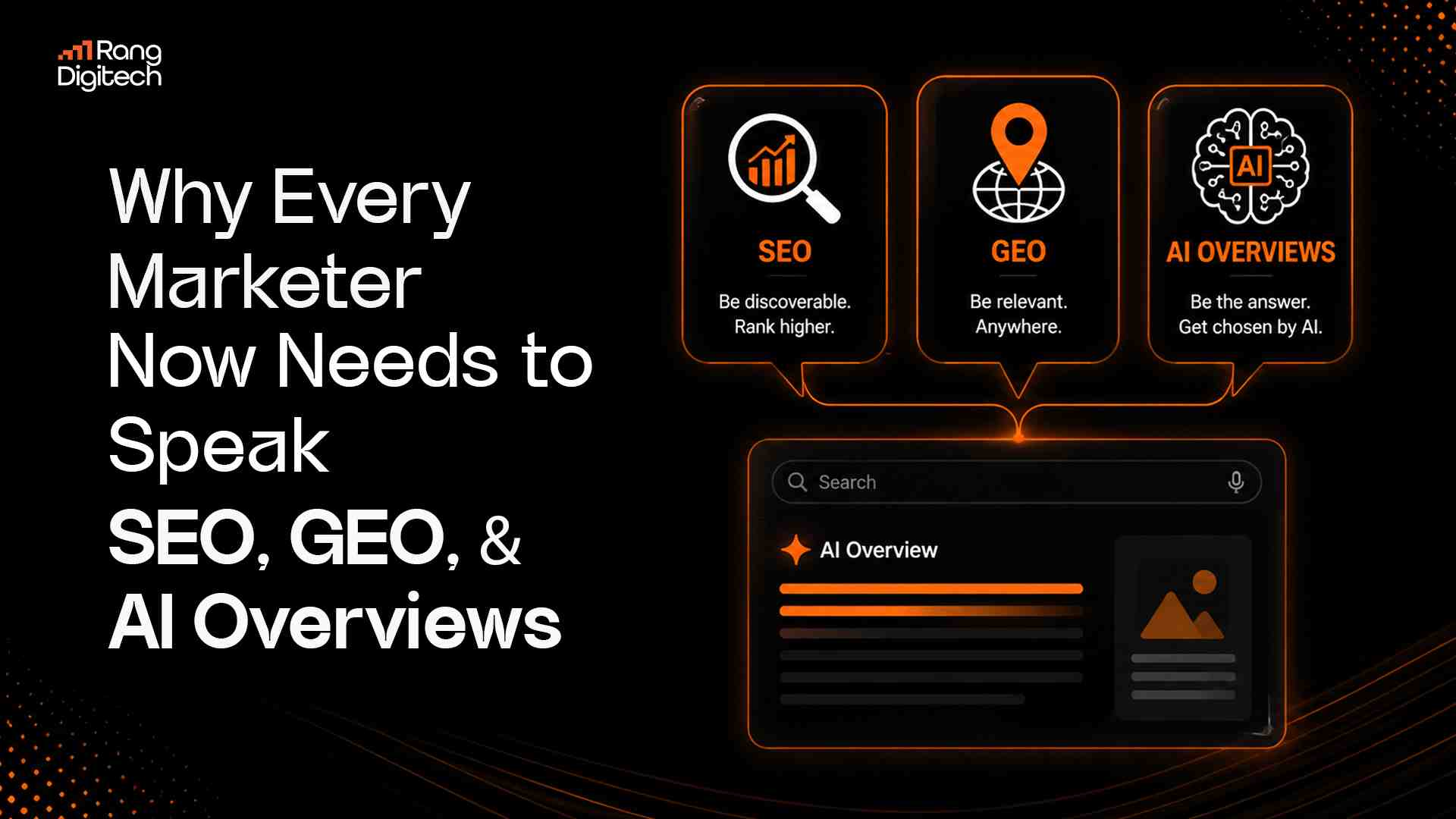
The call had been going fine until someone on the client side said the word GEO. Not the country-targeting kind. Not geography. A pause settled over the Zoom grid, six faces doing the same quiet math, and then somebody asked the question everyone was thinking: is that a typo for SEO?
It was not a typo. It was 2026.
Search has changed its vocabulary faster than most marketing teams have changed their slide decks. A discipline that spent two decades organized around keywords and backlinks now has to answer to AI Overviews, entity graphs, and answer engines that skip the website altogether. None of this is impossible to follow. Most of it, once explained properly, is common sense wearing a new coat. What follows is a plain-English field guide to the terms now showing up in client briefs, industry newsletters, and increasingly, in the demands brands are making of agencies like ours, especially those looking for SEO services in Ahmedabad.
SEO: The Discipline That Refuses to Retire
Search Engine Optimization is the practice of shaping a website so that search engines understand it, trust it, and rank it. That has not changed. What has changed is the shape of the reward. For years, ranking on page one of Google was the finish line. A click followed, then a visit, then, with luck, a sale.
SEO is not dying, whatever the panicked LinkedIn posts suggest. It is the foundation every other term on this list still stands on. Clean site architecture, fast load times, genuinely useful content, and a site Google can crawl without tripping over itself remain non-negotiable. The newer disciplines below do not replace SEO. They sit on top of it. For businesses seeking SEO services in Ahmedabad, understanding this foundation is essential to building a sustainable search strategy.
The foundation held. It just grew a second story.
AI Overviews: When Google Answers Before You Even Scroll
Search a question on Google now, and there is a decent chance the answer appears before a single blue link does. That box, generated by AI and sitting above the traditional results, is an AI Overview. It pulls from multiple sources, synthesizes them into a paragraph or two, and often gives the searcher everything they came for without a single click.
For a brand, this is both a gift and a threat. A gift, because being cited inside that box puts a name in front of a searcher at the exact moment of intent. A threat, because a well-answered question in an AI Overview means the searcher may never scroll down to the website that supplied the answer in the first place. Being the source Google trusts enough to quote has become its own kind of ranking, separate from the traditional list below it.
GEO: Writing For The Machine That Summarizes You
Generative Engine Optimization is the practice of shaping content so that AI tools like ChatGPT, Perplexity, and Google's own Gemini-powered search choose to reference, quote, or recommend a brand when generating an answer. Where SEO optimizes for a ranking algorithm, GEO optimizes for a language model deciding which sources are worth summarizing. This is increasingly becoming a focus for any digital media agency working to keep brands visible across changing search environments.
The mechanics differ in ways that surprise most marketers on first hearing them. A generative engine does not care about keyword density the way a 2015 search algorithm did. It cares about clarity, structure, and whether a page actually answers the question a human is likely to ask in conversation rather than in search-bar shorthand. A page written like a Wikipedia entry, with clean definitions and well-organized facts, tends to get cited more than a page written like a sales brochure.
This is the part most agencies have not caught up to yet.
AEO: The Art Of Being The Answer, Not Just A Result
Answer Engine Optimization is a close cousin of GEO, aimed specifically at voice assistants, featured snippets, and any tool built to hand a user a direct answer rather than a list of links to sift through. Ask a smart speaker what the best fertilizer is for monsoon-season paddy, and whatever content that assistant pulls from has already won the only competition that mattered.
AEO rewards content structured the way a good customer service rep would answer a phone call. Direct question, direct answer, right at the top, with supporting detail underneath for anyone who wants to go deeper. Burying the answer under three paragraphs of preamble is the fastest way to lose this particular game.
Zero-Click Search: The Victory That Never Sends Traffic
A zero-click search is exactly what it sounds like: a search that fully resolves on the results page itself, whether through an AI Overview, a featured snippet, a knowledge panel, or a quick weather widget. The searcher gets their answer and closes the tab. No website visit, no session in Google Analytics, no line item in the monthly traffic report.
This has quietly rewritten what success even means. A brand can now win, in the sense of being seen and trusted by a searcher, without a single click landing on its site. Marketing teams still measuring performance purely by traffic numbers are, increasingly, measuring the wrong thing. A strong digital marketing and advertising agency understands that visibility, authority, citations, and recognition can matter alongside traditional traffic metrics.
Winning without a click still counts as winning. It just does not show up the way it used to.
Entity Optimization: Becoming A Name Google Already Knows
An entity, in search terms, is a distinct thing that Google's Knowledge Graph recognizes and understands the relationships around. A city is an entity. A public figure is an entity. A restaurant, a hospital, a software company - all of them can become entities the moment Google has enough consistent signal to say with confidence: this is a real, specific thing, and here is what it does, where it is, and what it is connected to.
Entity optimization is the work of feeding those signals deliberately. Consistent business information across every directory and platform, a well-built Google Business Profile, structured data markup on a website, and consistent naming across social platforms all contribute. The payoff shows up in unglamorous but valuable places, like a knowledge panel appearing beside a brand's name in search results, or an AI tool correctly attributing a fact to the right company instead of a competitor with a similar name.
E-E-A-T: The Four Letters Behind Who Google Trusts
Experience, Expertise, Authoritativeness, and Trustworthiness. Google folded these four qualities into its search quality guidelines years ago, and they have only grown more central as AI-generated content flooded the internet. The logic is straightforward: if a machine can write a passable article about knee surgery in four seconds, Google needs another way to tell the difference between content written by an actual orthopedic surgeon and content that merely sounds like one.
Author bylines with real credentials, original photography instead of stock imagery, cited sources, and content that demonstrates firsthand experience with a product or place all feed E-E-A-T. It rewards precisely the kind of specificity that generic, AI-churned content struggles to fake.
LLMS.TXT: The New Welcome MAT For AI Crawlers
Most website owners know about robots.txt, the small file that tells search engine crawlers which pages they are allowed to index. llms.txt is its newer relative, a proposed standard that gives AI models a clean, structured summary of what a site contains, written specifically for machine consumption rather than human browsing.
Adoption is still early, and not every AI platform reads it yet. But the direction is clear enough that brands moving first will have a head start once it becomes standard practice, the way robots.txt did decades ago.
The file is small. The advantage of having one early will not be.
None of these terms exist in isolation, and that is really the point. A brand that ranks well on Google but has never structured its content for AI Overviews is leaving half the modern search landscape unclaimed. One that chases every new acronym without a solid SEO foundation underneath is building on sand. The work now is holding all of it at once: the old discipline and the new one, the click and the citation, the ranking and the recognition. A capable digital marketing and advertising agency can help businesses bring these different areas together into one cohesive strategy while keeping SEO services in Ahmedabad at the centre of long-term search visibility.
That is the work we do at Rang Digitech every day, for brands who would rather stay ahead of the vocabulary than learn it the hard way, mid-client call, with a room full of quiet faces doing the same math. If you are ready to strengthen your search visibility and adapt your strategy for the changing search landscape, contact us today to discuss how our SEO services in Ahmedabad can help your brand stay ahead.